
Fauquier Deed Records by Instrument
Fauquier County deed records track every transfer filed in the local land-record system. These span colonial-era grants to last week's conveyances. A search can start with a grantor, a grantee, or a parcel description. The assessor's tax roll supplies the parcel number that ties a property to its deed. Some images are available remotely; others live only in courthouse books or on microfilm. To search Fauquier County property records by address, begin with the assessment roll. Then carry those details into the clerk's name indexes. An index result is a lead, not a title opinion.
| Deed Type | What It Does | Common Use |
|---|---|---|
| Deed | Records a conveyance and its described land | Trace the grantor and grantee |
| Deed of trust | Records a secured real-estate obligation | Search with releases or satisfactions |
| Easement or covenant | Records a use right or restriction tied to land | Read the instrument and legal description |
| Plat | Records mapped lots and parcel divisions | Compare subdivision and lot references |
| Judgment or financing statement | Indexes other claims or secured filings | Check the matching record group |
Do not treat a deed and a deed of trust as the same thing. The first records a transfer. The second belongs to financing. A release, satisfaction, cancellation, or discharge should itself appear in the deed records, so check the instrument reference and parcel description before assuming a lien is open or cleared. For a full title and encumbrance opinion, a title abstractor is the right source; the county's Record Room staff do not perform title searches.
Fauquier Grantor and Grantee Coverage
Fauquier's public Certified Dates table breaks the older image indexes down by direction and period. Both directions run long. Grantee and grantor images each span May 24, 1759 through 1913. They then continue from 1914 through 1969. The table lists deeds from January 1, 1970 forward. The remote-access pages disagree, though. One points to 1962 as the start for ordinary deed images. The historic indexes themselves are not the same as unrestricted public online access to the underlying images. The indexes cover a different record set than the images visitors can pull up freely.
| Record run | Coverage shown | How to use it |
|---|---|---|
| Grantor index images | 1759-1913; 1914-1969 | Find the party conveying the property |
| Grantee index images | 1759-1913; 1914-1969 | Find the party receiving the property |
| Deed category | 1970-current on Certified Dates table | Check the current public coverage entry |
| Other listed groups | Judgments, financing statements, marriages, wills | Choose the record group before requesting an image |
Treat the coverage table as a planning tool. Ordinary document results require approved SRA access, so confirm a specific image range with the clerk before relying on any apparent cutoff.
Reading Fauquier's Name Indexes
In a grantor-grantee index, the grantor gives up an interest and the grantee receives it. Start with the most conveyance you know. Wait, start with the most recent conveyance you know. Then read the prior owner's name as your next search target. Compare that instrument's description against the current parcel. Legal descriptions in Fauquier deed records often rely on a lot number, acreage, a road, or a metes-and-bounds call rather than a modern street address. Copy parcel identifiers exactly as the assessor formats them. A guessed reformatting can derail the search.
- Find the latest conveyance using the current owner as grantee.
- Record the grantor, grantee, date, instrument reference, and legal description.
- Search the grantor as grantee to locate that party's acquisition.
- Repeat while matching land descriptions and parcel references.
- Move to the image indexes, books, or microfilm when the web range ends.
- Grantor
- The party conveying the described interest.
- Grantee
- The party receiving the described interest.
- Chain of title
- The sequence of conveyances affecting the parcel.
- Book and page
- A volume and page reference in a deed book.
Fauquier Secured Remote Access
Fauquier's Secured Remote Access system serves approved users only. It is not an unrestricted public search site. The clerk requires an executed application and agreement, government-issued identification, and payment. The posted annual rate is $400 for up to two users. Each additional user costs $200, effective September 1, 2024. Renewal materials and payment are due at least two weeks before expiration. An out-of-state business must also provide a Virginia certificate. The clerk's SRA page sets out the current terms. The official sign-in screen displays only the access gate and approved-user notice. See the Fauquier secured land-record login to view it. Access stays limited to approved users. The login page alone does not show whether every historic deed image is online.
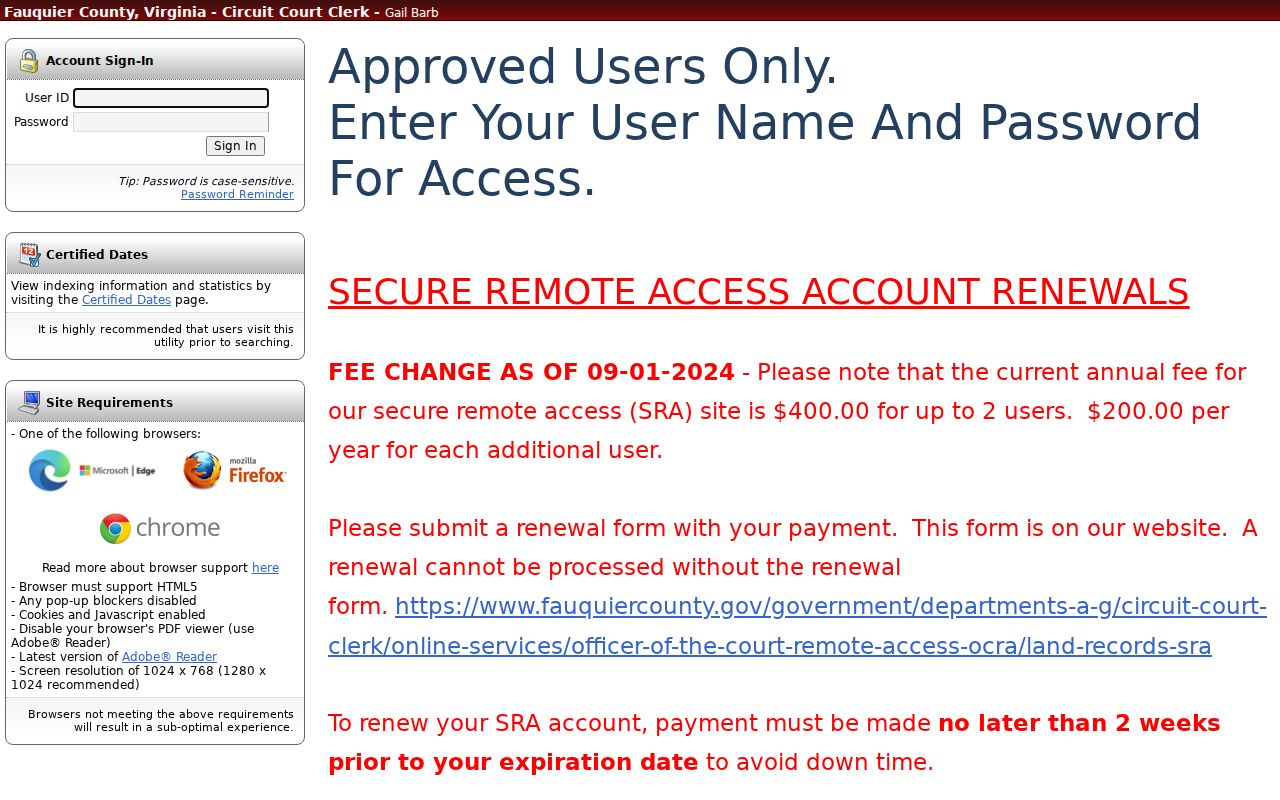
The two county pages disagree about the older image start date. Confirm the period with the clerk before subscribing solely for one historical document.
Fauquier Record Room Copies
The public Record Room sits at 29 Ashby Street in Warrenton. It holds deed books from 1759 to the present. Wills, marriages, chancery, historical registers, and other county records are there too. A walk-in search is one alternative to paid remote access. Staff can search a defined period of up to ten years when the document reference is unknown. They do not conduct title searches or detailed family research. For mail requests, name the document type and party. Include a book-and-page reference if known. Enclose a return envelope with enough postage. Copies cost 50 cents per page. A certification of a deed or will adds $2 per document. That fee sits on top of the page charge. The Fauquier Circuit Court page posts the public contact and hours. That helps distinguish the Record Room schedule from the recording cutoff.
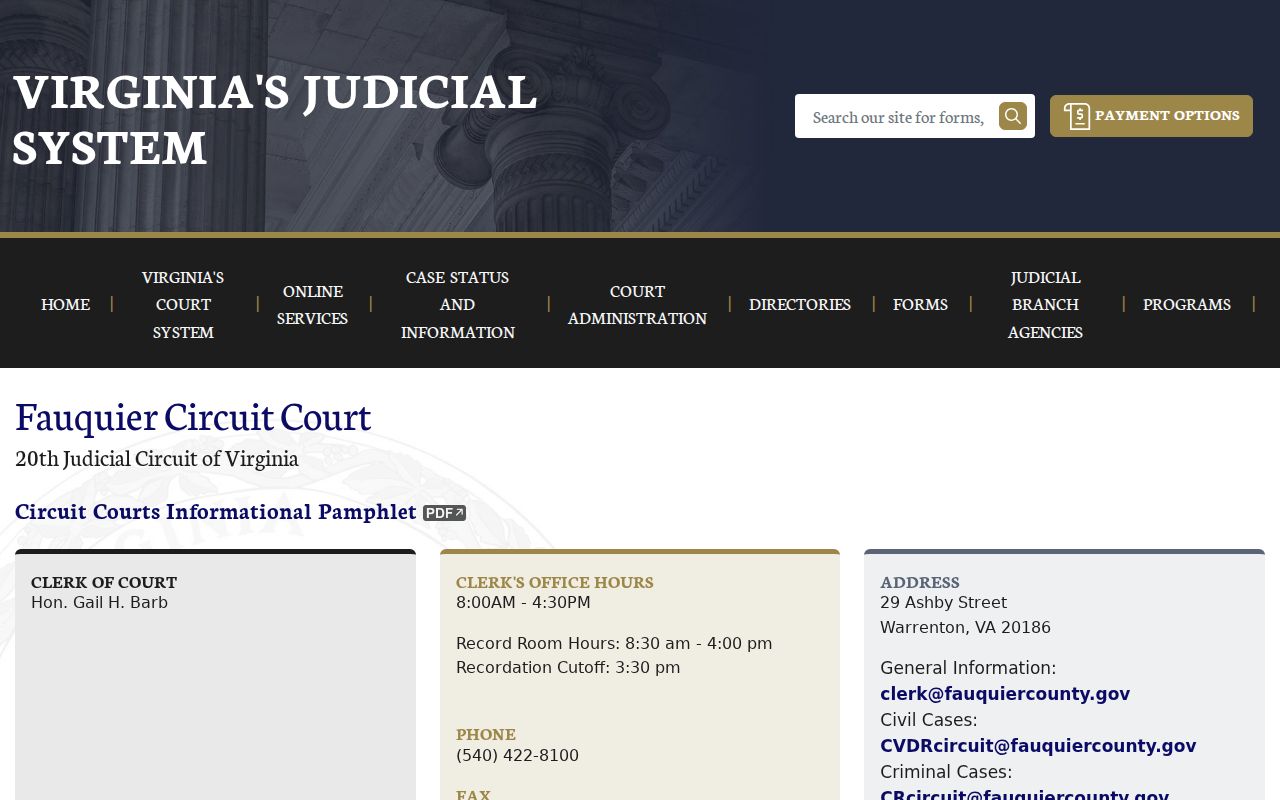
Check the posted schedule before visiting. Call the Record Room if a specific book, instrument, or copy request needs confirmation.
Fauquier Deed Books and Microfilm
Fauquier County's land-record trail starts in 1759. Deed Books 1 through 4 cover 1759 to 1772. The Library of Virginia holds letter-range grantor and grantee index runs through 1914. The collection reaches past deeds alone. Land causes from 1759 to 1807 and 1809 to 1850 sit alongside marriage bonds and returns and early vital records. These older materials matter when a chain of title stretches beyond what a modern property search covers. The Fauquier microfilm finding aid names the collection and offers a clean entry point. Its land-record category appears beside related county record groups. The Record Room holds county deed books as another source. Land tax books run 1855 to 1999. The county reports missing years among them, since fragile volumes could not all be retained.
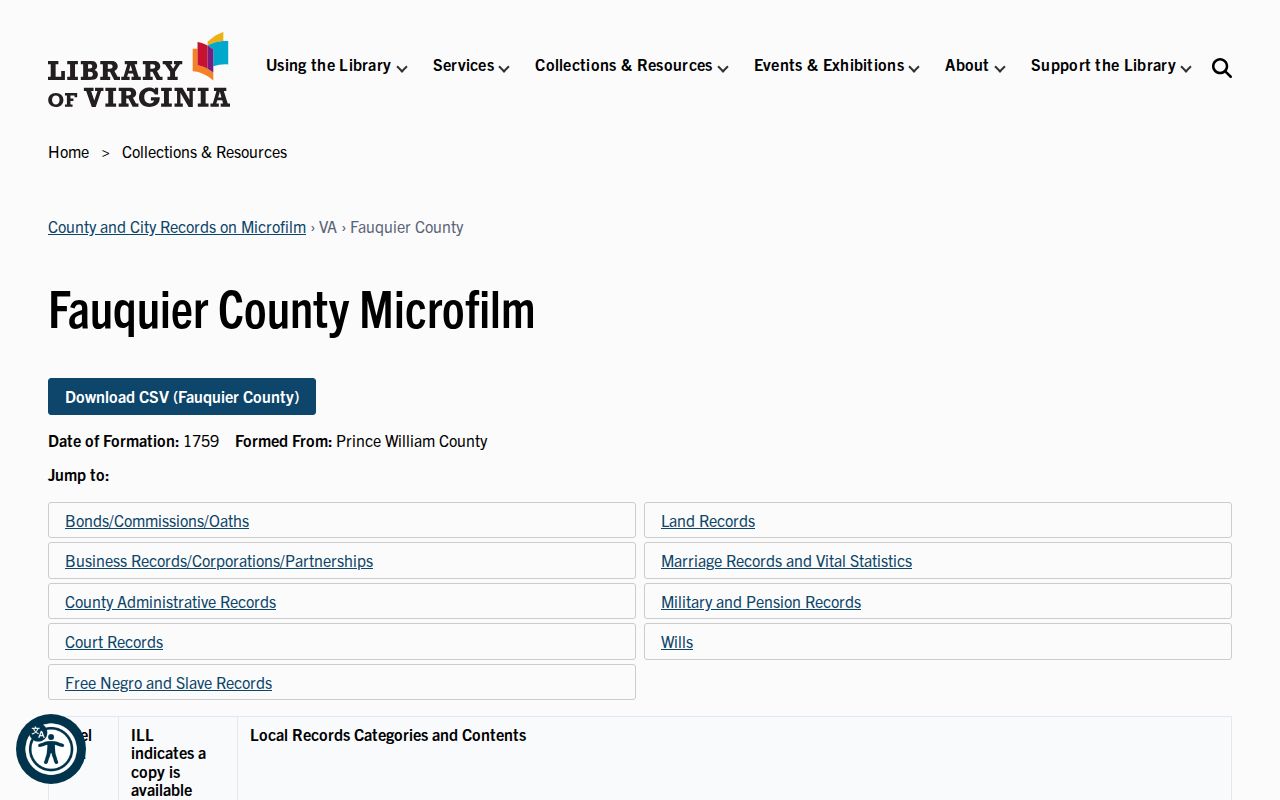
The finding aid points to the right historic series. It does not supply the book or index entry itself, so a document reference still has to be pinned down separately.
Fauquier's Separate Land Causes
The Library of Virginia's finding aid flags a Fauquier quirk. Deeds, wills, and related papers from the Superior Court of Law are left out of the general deed and will index. That gap can snap an otherwise careful chain. Do not assume the property changed hands off record. Turn instead to the separate land-causes material. Frame the archive request around the parcel's legal description and party names. The finding aid lists land causes in two early ranges. These are 1759 to 1807 and 1809 to 1850. Those are the full spans. This is a Fauquier-specific lead, not a claim that every transfer appears in those files. So weigh any cause result against the later recorded deed and the current assessment parcel.
Fauquier Releases and Recorded Debt
A property file can hold more than deeds. A deed of trust, mortgage instrument, judgment, financing statement, easement, or lien may attach to it. The Certified Dates table lists financing statements and judgments from July 1991, with a separate judgment index spanning 1984 through June 1991. The SRA description puts UCC images beginning May 2025. Search by the right record category and party names. One index rarely covers every instrument. Paid-off debts leave their own trail. Look for a recorded release, satisfaction, cancellation, or termination. Never assume an older entry is inactive, or that a missing assessor flag proves it was cleared. Copy rates and the Record Room route apply here too. County staff do not perform title and encumbrance reviews, so a title abstractor should handle that work.
Getting a Fauquier Deed Copy
Your best route depends on the document and how you reach the courthouse. Walk-ins can research deed records in the Record Room. An approved SRA account may allow remote index and image access within its covered range. Mail requests work too. Name the document type, the parties, and the book and page reference. Include a prepaid return envelope. Older indexes and deed books are also available on microfilm. They can be reached through the Library of Virginia's collection.
Recorded, not guaranteed. A Fauquier deed index shows filed instruments, not a complete title opinion. The Clerk directs researchers seeking title history to a title abstractor.
Fauquier Deed Recording Hours and Copies
Separate public research hours from document-recording cutoffs when planning a visit. The Record Room is open 8:30 a.m. to 4 p.m.; the clerk's office operates 8 a.m. to 4:30 p.m. Walk-in and mailed recording services accept instruments through 3:30 p.m., while the e-recording cutoff is 2 p.m. A late arrival may still be able to research a book but should not assume a document can be recorded that day.
Ordinary copies cost 50 cents per page. A certified deed or will adds $2 per document plus the page charges. The Record Room is at 29 Ashby Street, Warrenton, Virginia 20186; call 540-422-8087 about recording and 540-422-8100 for the Circuit Court. Confirm hours before traveling because courthouse schedules and office procedures can change.