
Tracing Former Fauquier Property Owners
Fauquier County keeps a deep trail for anyone tracing past owners of record. The public Certified Dates table lists modern deeds from 1970 forward. Older transfers sit in separate grantor and grantee image runs covering 1759 through 1969. Each deed yields the next name to search. A legal description ties the whole chain to the land itself. The Certified Dates table works as a full inventory of each transfer. It is not a sample of one parcel. Accessing the live index itself requires an approved SRA account with the county.
| Source | Years It Covers | Where Held | What It Shows |
|---|---|---|---|
| Latest conveyance | Date printed on deed | Current grantee to prior grantor | Instrument type and book/page or number |
| Prior conveyance | Date on preceding deed | Prior grantee to earlier grantor | Compare parcel description and reference |
| Historic index run | 1759-1913 or 1914-1969 images | Fauquier grantor and grantee indexes | Locate the book and page for an earlier transfer |
| Deed book or land cause | Early county record period | Record Room or Library of Virginia microfilm | Read the instrument and any separate court file |
A recent Fauquier County transfer is the easy place to begin. Start with the latest deed and work backward through the clerk's index. For older owners, find the year where the index changes. Then turn to the matching image run or book. The Library of Virginia lists the books along with index letter ranges. The county Record Room holds deed books from 1759 to the present. A plat helps confirm that successive descriptions point to the same lot.
Walking the Fauquier Deed Chain Backward
Every Fauquier County conveyance hands you the next search. The deed supplies both the names and the land description. Today's grantee becomes the party you look for in an earlier index run. Keep alternating direction as you go. Someone who received land in one deed likely conveyed it as grantor. That grantor deed is the next relevant instrument. Search the exact name. Then compare acreage, lot, road, and subdivision before linking two deeds together.
- Use the current assessment owner and PIN to find the latest deed.
- Write down the date, grantor, grantee, instrument type, reference, and legal description.
- Search the current deed's grantor as grantee in the prior record period.
- Repeat backward and compare the land description at every transfer.
- Move to historic image indexes, books, or land causes when needed.
- Grantor
- The party conveying the stated interest.
- Grantee
- The party receiving the stated interest.
- Chain of title
- The linked sequence of recorded transfers affecting the parcel.
- Legal description
- The deed's written description of land, which can outlast a street name.
Fauquier's Early Deed Books
Fauquier County's colonial deed books open in 1759. The Library of Virginia finding aid maps the early volumes. Book 1 runs from 1759 to 1763. Book 2 ends in 1767, Book 3 in 1770, and Book 4 in 1772. Grantor and grantee index images are split into letter ranges. They reach from 1759 to 1914. The books hold the instrument text; the index tells you where to look.
The Fauquier microfilm collection page groups deed books, indexes, and land causes together. The county collection page displays its land-record category and related holdings. When a chain reaches an early book, note the index letter range first. Then request or view the matching volume rather than relying on a modern address search.
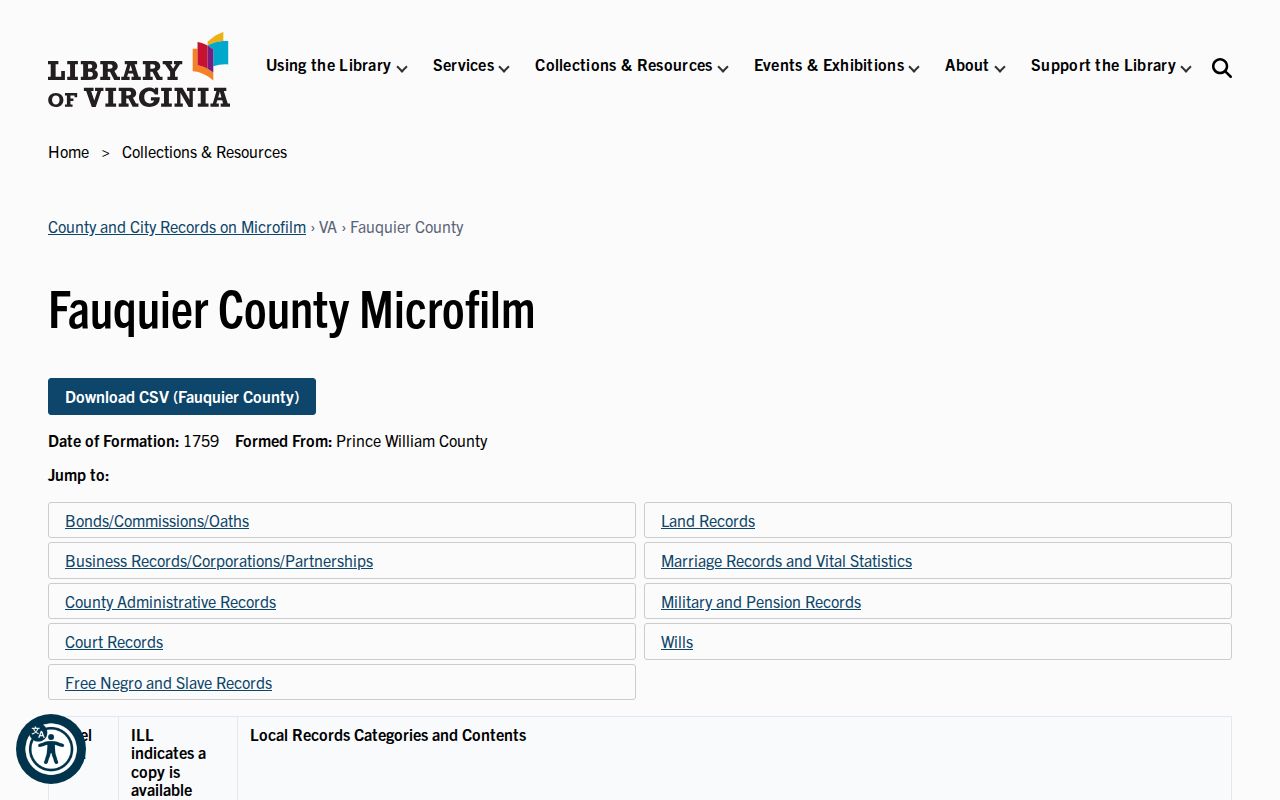
A finding aid is only a catalog. The scanned deed book or index is where an actual chain entry lives.
Fauquier Index and Image Cutoffs
Fauquier County deed records split into two worlds. The Certified Dates page lists records from January 1970 forward. Separate older grantor and grantee image ranges appear as well. Public SRA material gives conflicting start years of 1962 and 1970. The number depends on the county page. None of that means every deed image is free to search online. The full remote system serves approved subscribers only.
The Certified Dates table is public and shows coverage by record group. A chain may reach past the ordinary remote period. The Record Room and the Library of Virginia are then the places to work. The clerk publishes no firm public cutoff year for unrestricted index searching. Ask about a specific name and period instead of guessing where the open web ends.
The Fauquier secured land-record login shows the current remote-access conditions. That sign-in gate is for approved users. It is not an open deed search.
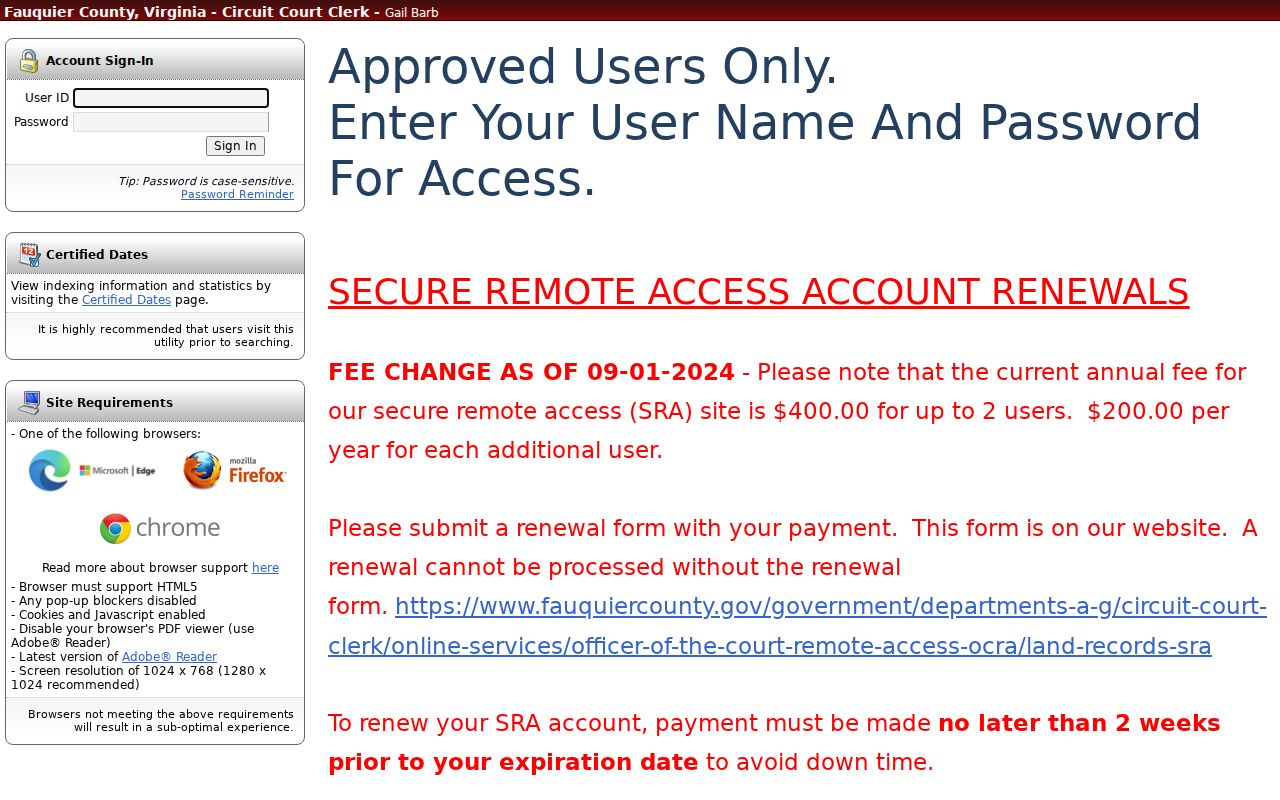
Researchers without SRA approval still have paths. They can request copies, or work through historic indexes and deed books in the public Record Room and archive.
Older records. Fauquier's historic books and indexes go back to 1759, but that does not mean a free public web index reaches that year. Confirm access for the period you need.
Fauquier's Separate Court Land Causes
A backward chain has a gap worth knowing. Per the Library of Virginia finding aid, the general deed and will indexes omit some records. Superior Court of Law deeds, wills, and related material are missing from them. A Fauquier transfer or property order may sit in that separate court series. The same finding aid lists Fauquier land causes. The dates cover 1759 to 1807 and 1809 to 1850.
A deed chain may stop in an early period. Ask whether a court proceeding touched the parcel. Search by name and legal description, then compare any order or cause with later deeds. A missing general-index entry proves nothing about whether a transfer occurred. Some records fall outside the listed runs. The archive or clerk can say which series holds the file.
Fauquier Land Tax Books and Gaps
Fauquier County's Record Room keeps land tax books covering 1855 through 1999. Some years are gone. Fragile volumes could not be kept. When a deed reference resists tracing, a yearly assessment can offer another clue. An entry alone never conveys the property. Read it as a pointer toward the deed, probate order, or court file. That document actually transferred title.
Note each owner, year, acreage, and district description. Then weigh that entry against neighboring years and the recorded deed chain. A gap in the tax books may simply mean a volume went missing. Check the Record Room holdings list before building a request around one year. Gaps do not always signal changed ownership.
Names and Fauquier Legal Descriptions
Older Fauquier County instruments often spell names differently. They may also describe land in ways modern parcel data ignores. A deed may identify property by acreage, an adjoining owner, a road, or a stream. It may also cite a lot layout that has long since changed. Search again with each name variant the index shows. Compare the actual land description before tying any record to today's parcel.
Estate transfers complicate things further. A will, a fiduciary order, an executor deed, a commissioner deed, or a partition can explain a shift in the owner of record. It can happen without any ordinary sale deed appearing. Virginia SCC records help sort out a corporate name. They will not reveal a trust's beneficial interests. Keep every document reference in sequence. Then separate a probate order from a deed that conveys the parcel itself.
Fauquier Records Beyond Remote Access
If SRA image limits or account rules block the search, the Record Room remains the public fallback. Its deed books run from 1759 to the present. Staff can search a defined span of up to ten years when the reference is unknown. The clerk will not perform a title search, though. Mail requests should state the document type, party name, and book and page if known. Include a return envelope with adequate postage.
Copies cost 50 cents per page. Certification of a deed or will adds $2 per document on top of the page fee. The Record Room instructions cover both walk-in and mail access. For historic images, the Library of Virginia's microfilm page offers another route. A title abstractor is the right choice when a full ownership opinion is needed.
How Far Back Fauquier Owners Go
Recorded land in Fauquier County reaches back to the 1759 deed books. The Library of Virginia preserves the early deed and index runs. Yet deep coverage is not the same as an open online name search, so read the public Certified Dates page and the SRA description separately, since the clerk's own pages disagree about older deed-image coverage.
Lawful use. Use prior owner information for property history and title research. Do not use it to track, harass, or threaten a living person.