
Fauquier Property Tax Record Fields
Two offices hold Fauquier's tax records. The Commissioner of the Revenue keeps the assessment roll and cadastral details. The Treasurer keeps the bills, balances, payments, and delinquency. The county links the Real Estate Online search from its taxpayer portal. But a value on the assessment roll and an amount due are different fields. They also have different custodians. Pull the parcel's PIN and follow it across both sources. That one number is the cleanest way to see how a single Fauquier parcel sits in each system.
| Field | What It Shows | Where |
|---|---|---|
| Owner and parcel | Owner of record, situs, mailing address, PIN, legal description | Commissioner of the Revenue |
| Land and improvements | Assessment components and total value on the county roll | Real Estate Online |
| Use value or relief | Special assessment or exemption treatment, when applicable | Real Estate Division |
| Bill and balance | Current amount due, payment, and account status | Treasurer Taxpayer Portal |
| Appeal record | Review or Board of Equalization filing and supporting material | Commissioner / Board process |
An assessment is the county's valuation for tax purposes. A bill reflects the tax account, its due dates, and any adjustments. Neither one is a sale price. A recorded deed shows what a buyer actually paid. That transaction figure lives in deed records, not on the parcel card. Field labels on live parcel cards vary, so read what the current record actually displays. Treat any estimated market value as an estimate, never a guaranteed sale amount.
Fauquier Tax Account Lookup
The Fauquier County Taxpayer Portal offers two routes. One is an account login. The other is a Quick Pay path that needs no sign-in. Its home screen points visitors to the assessment search for general real-estate assessment information. The login form asks for email and password. Quick Pay asks for the tax account number and a payment method. The portal publishes no public search by address. So work from the PIN or the account details printed on a bill. The Treasurer's office can match a parcel when those details fall short. Open the official Fauquier Taxpayer Portal for the live account. Its home screen displays both the login and no-sign-in payment routes side by side. It also notes that card payments carry a convenience fee. Payment by e-check is free.
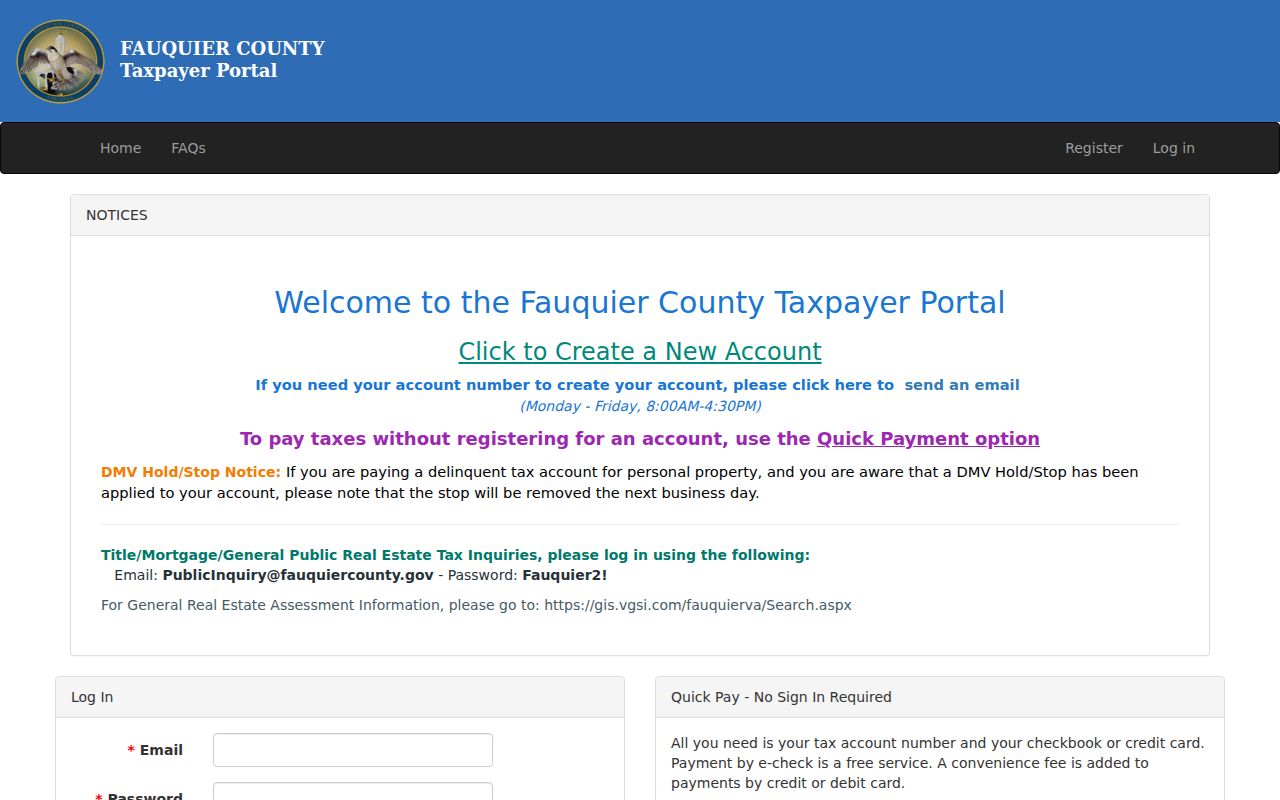
Start with the balance and payment status. Then keep the receipt with the parcel's PIN. A tax bill proves what the Treasurer's account shows, not title to the land. For ownership, the recorded deed is the record that counts. Quick Pay fits when a bill is in hand. No saved portal profile is needed. Match the account and tax year printed on the notice. Review the amount before submitting, and again on the payment confirmation. The card fee is a processing charge, not an extra real-estate assessment. The portal's free e-check option may suit better when its terms fit. Keep the receipt with the account record. Payment may not appear right away.
Checking a Fauquier Tax Bill
Let the question pick the tool. If the issue is what has been billed or paid, use the Treasurer's portal. If the issue is how Fauquier valued the land, go to the assessment roll instead. A notice can arrive after an assessment change. It may still say nothing about whether a bill was paid. The county portal offers Quick Pay without an account login. A separate login handles saved account access.
- Use the tax account number from the bill for Quick Pay, or sign in to the taxpayer portal.
- Confirm the parcel and tax year before reading an amount due.
- Compare the assessment owner and PIN in Real Estate Online.
- Ask the Treasurer to clarify a payment, balance, or parcel mismatch.
- Assessed value
- The county's valuation entry used in the tax process.
- Taxable value
- The value after applicable adjustments, before the bill calculation.
- Tax account
- The Treasurer's record of charges, payments, and balance.
- Tax lien
- A recorded or legal claim tied to unpaid tax; confirm status with the custodian.
Fauquier's 2026 Assessment Cycle
Fauquier's latest reassessment took effect January 1, 2026. The county reported about a 22.3 percent rise in total assessed value. Residential values rose about 21.9 percent. Before land-use, elderly or disabled, and disabled-veteran adjustments, taxable value climbed about 26.82 percent. Those are countywide comparisons, not parcel-level estimates. Per the county FAQ, the 2026 reassessment was performed in-house. The next effective date is January 1, 2028, as Fauquier moves to a two-year cycle. The Real Estate Division also posted a software-conversion notice. It asks owners to review their parcel information and send corrections to retax@fauquiercounty.gov. The Fauquier assessment search is the lookup entry point. Its opening screen shows name fields. But the parcel result page is where an owner should confirm the displayed value components.
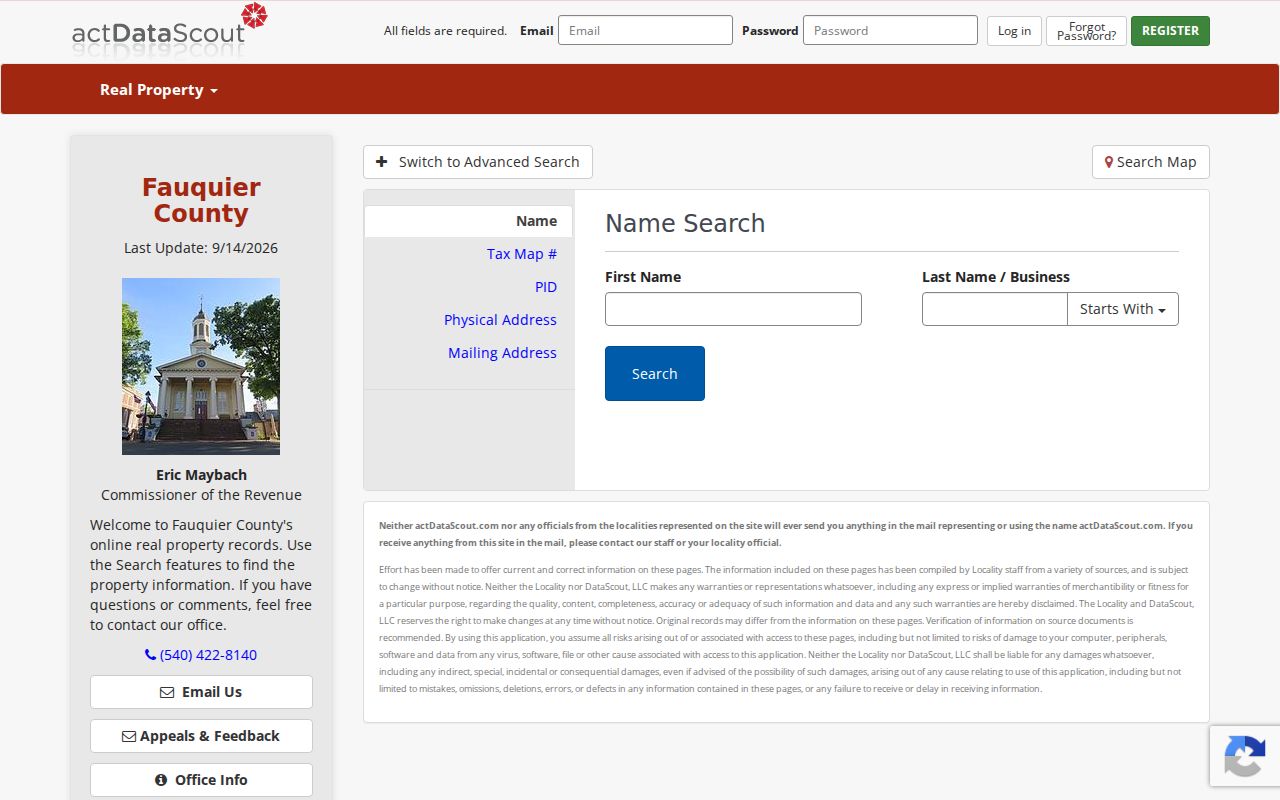
Compare values for similar parcels. Read the land and improvement split where it appears. A countywide rise does not prove any single assessment is wrong, so a challenge should rest on the parcel record itself and Fauquier's current appeal process.
Fauquier Land Use and Taxable Value
Fauquier's use-value program can assess qualifying agricultural, forest, or open-space land below market value. The basis is soil and productivity. The county requires annual revalidation. When a qualifying use changes, rollback tax can reach back over the five prior years plus the current year. Interest runs at 10 percent. That treatment is why taxable value can diverge sharply from the ordinary assessment comparison used for a house or commercial lot. Look for a use-value or exemption indicator on the assessor entry. Then ask the Real Estate Division which filings and documentation are current, since each program carries its own eligibility rules. A conservation easement and a PDR notation also change how a parcel is described. Do not assume either one creates the same tax treatment.
Fauquier Tax Relief Programs
Fauquier County handles property tax relief through two distinct programs. One serves elderly and disabled owners. The other is a disabled-veteran exemption. Elderly and disabled relief turns on age, occupancy, income, net worth, and disability documentation. The veteran exemption applies to a 100 percent service-connected permanent disability. None of these determinations shows up in a standard assessment search. Eligibility is decided program by program.
The county's current elderly and disabled tax relief page and the separate disabled-veteran exemption page carry the filing materials. They also carry the full requirements. Income and net-worth limits change. Confirm them there rather than trusting an old application or a third-party summary.
A name search will not carry an application through. The process weighs the qualifying person's age or disability, occupancy, income, and net worth. It also weighs supporting disability documents where the county asks for them. For veterans, the exemption stands on its own. It requires a permanent service-connected rating of 100 percent. Pull the current county form for household definitions, ownership conditions, and renewal dates. An assessment card alone never shows whether relief was granted.
Fauquier Tax Dates and Delinquency
Real estate taxes in Fauquier County are billed semiannually. Installments fall due June 5 and December 5. A 2 percent late penalty applies at the due date. The penalty climbs to 10 percent on the first day of the following month, after which annual interest of 10 percent begins to run. These charges attach to real estate tax only. The portal's DMV hold notice concerns delinquent personal property, not every real-estate account, so read it carefully before assuming it applies to a parcel.
The Treasurer's taxpayer responsibilities page posts the current rules. When a payment posts to the wrong account or year, hold onto the confirmation details and contact the Treasurer's Office. An older tax entry should not be treated as unpaid without checking the current account and any recorded release or satisfaction.
Appealing a Fauquier Assessment
Fauquier County's 2026 appeal cycle sets separate deadlines for administrative review, the Board of Equalization, and a supplemental filing. March 1 governs the administrative appeal. June 17 is the Board date. October 1 closes the supplemental window. Those dates belong to the 2026 assessment alone. They should never be carried into a later year. Before filing anything, review the county's current application, instructions, and evidence requirements.
A strong appeal file pins down the exact parcel. It also identifies the piece of the assessment under challenge. Include the notice, the PIN, land and improvement figures, and recent comparable sales. Add any property facts that bear on value. For acreage or a split parcel, add the relevant plat or legal description. That way the reviewer can see which land the evidence covers. Follow the county's current instructions for the proper administrative or Board route rather than sending one package to the tax-payment portal.
Appeal window. The 2026 county schedule lists March 1 for administrative review, June 17 for the Board of Equalization, and October 1 for a supplemental filing. Check the current cycle's county page before submitting.